
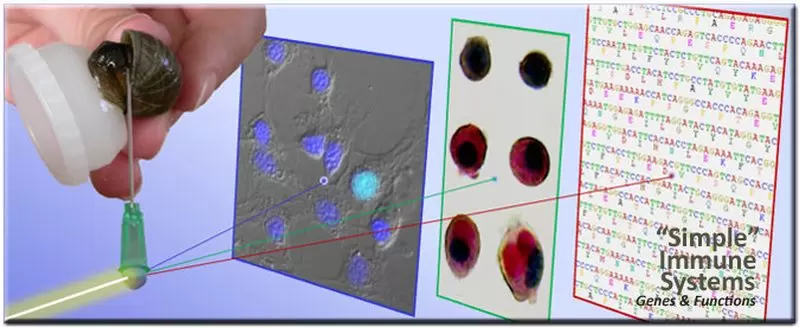
About
We conduct research in the field of comparative transcriptomics and the evolution of invertebrate immune systems. The evolutionary diversity of immune genes and immunoassociated molecular complexes forms the basis for various long-term survival strategies of species, populations and individuals. Our studies mainly use sequencing data, include assembly and annotation of transcriptomes, analysis of protein sequence homology, phylogeny and taxon-specific structural features.
A large part of our research focuses on the early natural history of the innate immune system of invertebrates from the vast and heterogeneous group Lophotrochozoa (molluscs and worms). The immune conflict of these animals with tissue parasites is the focus of attention, as they are often vectors of infections dangerous to humans and domestic animals. Particular attention is being paid to the genetics of polymorphic pathogen receptors, associated molecular complexes and associated intracellular signal transduction molecules. The aim of this research is to find promising candidate genes for in-depth analysis and the potential development of innovative methods for the control of human and animal diseases.
The main results and achievements:
The immune transcriptomics of Caenogastropoda
We have introduced into comparative immunobiology a new experimental model to investigate host-parasite immune conflict: the long-lived marine gastropod mollusk, common periwinkle Littorina littorea and its trematode parasites. Several species of these tissue parasites use L. littorea as a first intermediate host, overcoming the mollusk’s immune responses with a wide range of tactics that differ radically in different species and at different stages of development. The common periwinkle immune system is quite effective against trematode invasion, and even a successfully established parasite causes a chronic host immune response. This response is present at a low but stable level and may be involved in the selection of the most adapted parasite clones.
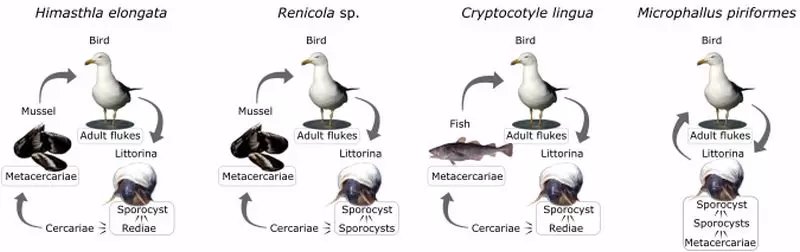
The anti-trematode immune response of Littorea is not generalized, it is tissue-specific and mainly mediated by cellular rather than humoral responses. The repertoire of immune polymorphic receptors recognizing the parasite in periwinkles includes various secreted and membrane-associated proteins of lectin nature. In mollusks, such proteins are major factors in the immune ‘self/nonself’ discrimination.
The comparative analysis showed that the characteristic vulnerability to trematode infections in gastropod molluscs is generally due to taxon-specific features of their immune system, which differ from members of other mollusc classes. In particular, the immune strategy of bivalves relies on less specific cellular responses and a more generalized humoral response to infection. These differences were formed during the divergence of Bivalvia and Gastropoda from a common ancestor and are evident, among others, in the taxon-specific features of complement-like molecular complexes.
Evolution and diversity of complement-like molecular complexes
We have analyzed the evolution of the complement system, a molecular complex that acts as a bridge between innate and acquired immunity in humans and other mammals. The search for ortho- and homologous genes encoding the central proteins of the complex revealed related molecules in the genomes and transcriptomes of invertebrate animals and allowed us to formulate a hypothetical model of the evolution of complement-like systems.
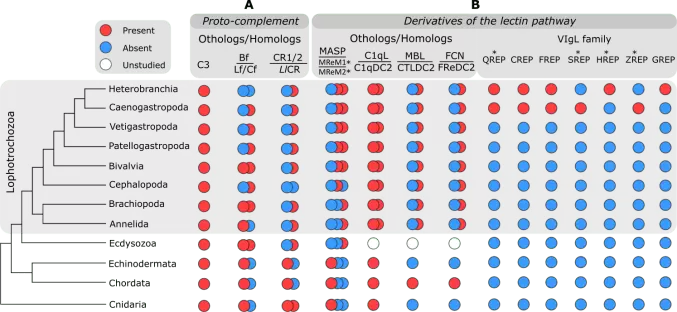
Systems which are similar to the mammalian complement system are based on thioether-containing proteins (TEPs) carrying a thioether (TE) motif. Upon activation, the TE motif binds to the closest available hydroxyl and amine groups present on all biological surfaces, including pathogens. The hypothetical ‘proto-complement’ that has emerged in the coelenterates (Cnidaria) is defined as the ancestral cascade that provides the minimal set of TEP-associated molecules necessary for TEP amplification, opsonization of the foreign target and its phagocytosis. In mammals, this cascade is represented by the thioester protein C3, the serine protease C2/factor B (Bf) and complement cell receptors (CR). Homologues of these molecules have been found in invertebrates, allowing us to trace important events in the further evolution of the proto-complement. The emergence of coelomic animals, possessing a mesoderm and an inner body cavity filled with a coelomic fluid (haemolymph) and numerous mobile cells (haemocytes, coelomocytes) was an important milestone on this pathway. The emergence of this new internal environment tissue is associated with the appearance of secretory recognition molecules associated with the proto-complement. The first of these molecules were the C1q-like lectins secreted into the coelomic fluid, they expanded the spectrum, increased the specificity of recognition of foreign targets, and became part of the “antique” immune complex, the next stage in the evolution of the proto-complement. The pathways and rates of further evolution of this system in different taxa turned out to be very different. Elements of the antique complex persisted in the basic groups of animals and were considerably modified or even disappeared in more specialized ones. An expansion of the repertoire and an increase in the specificity of recognizable patterns, as well as an acquisition of new molecular superstructures, the terminal effector cascades were the main evolutionary modification trends.
The proposed model of proto-complement evolution summarizes and largely organizes the scattered and fragmentary data on the structural and functional features of immunoassociated molecules described in representatives of various multicellular animal taxa. Moreover, it confirms the promise of analysis of invertebrate pattern-recognition molecules as candidates for possible genetically engineered modifications aimed at developing new and innovative methods of controlling dangerous infections.